Hello, this is MiTornAve.
In our last session, we explored RBFNN, which leverages "speed" as its ultimate weapon to react sensitively to local regions. In the world of control systems—where data can shift within milliseconds—the simple and rapid architecture of RBFNN has proven to be an exceptional solution.
However, real-world problems are rarely as clear-cut as a sharp numerical formula. "The room feels a bit warm; could you lower the AC appropriately?" This sentence, so natural to humans, is like an alien language to a computer that only understands 0 and 1. What exactly does "a bit" or "appropriately" translate to in digits? (It’s like a 'T' personality type trying to decipher an 'F's emotions using a calculator.)
Today, we will dive into Fuzzy Logic, a technology that implants human "ambiguity" and "intuition" into AI and control engineering. We will explore how machines mathematically process this vagueness, focusing on Linguistic Variables and Membership Functions.
1. What is Fuzzy Logic?: The Gray Area Beyond Black and White
Traditional Computer Logic (Crisp Logic): A Cold, Binary World
Traditional computer science and mathematics have been dominated by 'Crisp Logic' (or Boolean Logic). This system cuts the world into two extreme states: True (1) or False (0).
The Trap of the Step Function: Suppose we set the threshold for "Hot Weather" at exactly 30°C. In this system, the computer judges 29.99°C as "Not Hot (0)" and 30.00°C as "Hot (1)". The entire state of the world flips over a mere 0.1-degree difference.
The Fatal Limitation: If you controlled an air conditioner this way, the machine would vibrate between extremes—blasting at max power at 30°C and shutting off completely at 29.9°C. This oscillation, known as 'Chattering,' is far too rigid for the continuous changes of reality.
Fuzzy Logic: Translating Ambiguity into Math
In contrast, "Fuzzy" refers to things that are blurred or ill-defined. Fuzzy logic recognizes countless 'Degrees' between 0 and 1.
Degree of Membership: Instead of flatly concluding 29.9°C is "Not Hot," it interprets it smoothly: "It belongs to the 'Hot' set by 99% and the 'Cool' set by 1%."
Embracing the Gray Area: This isn't just "guessing." It’s about taking subjective human sensations like "It's quite warm" and breaking them down into real numbers (e.g., 0.85, 0.42) so that a computer can perform precise, flexible calculations.
2. Success in Traditional Automation: Replicating Expert Intuition
Before deep learning, Fuzzy Logic excelled in Automation Control by digitizing the "know-how" of experts.
2.1 The 'IF-THEN' Rule-base: Replicating the Expert's Brain
As noted in the dissertation (Kim Minsoo, 2019, Section 2.1.1), the core of a fuzzy system lies in structuring human knowledge into Linguistic Rules.
Rule 1: IF (Pollution is High) AND (Load is Medium) THEN (Increase detergent).
Rule 2: IF (Braking distance is Short) AND (Speed is Fast) THEN (Apply pressure Very Strongly).
2.2 Real-world Innovation: From Washers to Subways
Fuzzy Washing Machines: 90s washers used optical sensors to measure water turbidity. If the water was "slightly" cloudy, it judged the oil stains were "low" and adjusted the cycle in real-time.
The Sendai Subway (Japan): Traditional PID control resulted in jerky braking. Fuzzy control imitated a veteran driver: "The station is getting closer and speed has slowed appropriately, so let's maintain the brake smoothly." This led to a 10% reduction in power consumption and significantly smoother rides.
3. How AI Understands "Appropriately": Linguistic Variables & Membership Functions
To act as a mathematical backbone for modern AI, Fuzzy Logic relies on two key concepts:
3.1 Linguistic Variables
Computers calculate with numbers, but humans think in words. Linguistic variables act as the translator.
Numeric Variable: Temperature = 25°C
Linguistic Variable: Temperature = {Very Cold, Cold, Moderate, Hot, Very Hot}
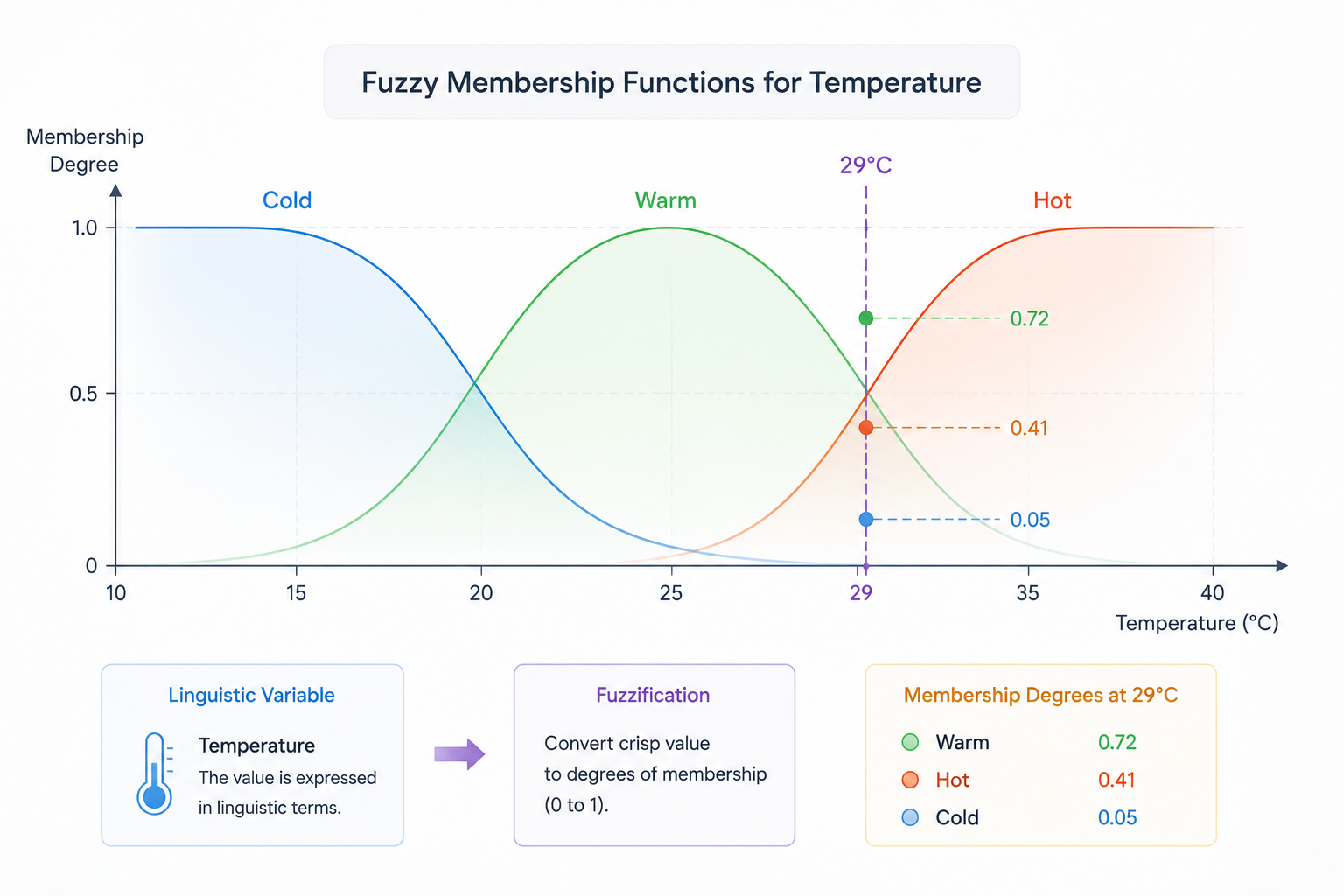
3.2 Membership Functions
This function determines "how much" a specific data point belongs to a linguistic set, converting values into a range between 0 and 1 (Fuzzification). The Gaussian Function we saw in RBFNN is widely used here:
\mu_A(x) = \exp\left(-\frac{(x - c)^2}{2\sigma^2}\right)
x: Current input (e.g., Temperature).
\mu_A(x): Degree of membership in set A (0 to 1).
c / \sigma: Center and width of the set.
4. The Limits of Fuzzy Logic: The Need for Evolution
While Fuzzy Logic is excellent for complex non-linear systems, it faces a major wall as industrial environments grow more complex.
4.1 Expert Dependency: High Barrier to Entry
My dissertation highlights 'Expert Dependency' as a primary challenge:
The Tuning Trap: Humans must manually define the membership function shapes and parameters (c, \sigma).
Subjectivity: If an expert's knowledge is incomplete, the entire system's reliability collapses.
4.2 The "Rule Explosion"
Curse of Dimensionality: If input variables increase, the number of IF-THEN rules explodes into the thousands. It becomes impossible for a human brain to manage and ensure consistency across such a massive rule-base.
4.3 The Absence of Learning Ability
Traditional fuzzy systems are 'Static.' Unlike Neural Networks (NN), they cannot look at data and update their own parameters.
The Conclusion: Human intuition is great, but we desperately need an 'Automatic Learning Ability' that can find rules from raw data.
"Fuzzy's intuitive reasoning is powerful, but can't it learn on its own like a Neural Network?"
This question led to the FNN (Fuzzy Neural Network), which combines Fuzzy flexibility with ANN learning—a major focus of my research.
📌 Key Keyword Checklist
Crisp Logic: Strict binary logic (1 or 0).
Degree of Membership: A value between 0 and 1 indicating how much something belongs to a set.
Linguistic Variable: Variables expressed in words rather than just numbers.
Membership Function: The translator that converts crisp data into fuzzy values.
IF-THEN Rules: The logic structure that implants expert experience into machines.
Expert Dependency: The limitation where humans must manually design rules and functions.
We will explore the synergy created when Fuzzy Logic meets the Backpropagation technology of Neural Networks!