'Hello World' is a sentence that anyone studying computers has likely heard at least once. If you haven't, you are probably not a computer major or someone interested in engineering.
While most people just let it pass by, many—including myself—are curious about its origin. Most likely, you have a memory of searching for it at least once.
How Did 'Hello World' Become the Standard Greeting in Programming?
The phrase "Hello, World!" that we mindlessly type when learning a new technology carries a meaning beyond mere custom. This phrase has breathed alongside the history of computer science, accompanying the first steps of millions of developers. Thus, one could venture to say that this sentence encapsulates the excitement and fear of learning a new language.
Bell Labs in the 1970s: 'Hello World' Started with the B Language
To understand the birth of 'Hello World', we must travel back to the early 1970s at Bell Labs, where legendary developers were gathered.
1.1 The B Language and Brian Kernighan's Experiment
Officially, the creator of this phrase is Brian Kernighan. He first used this greeting in an internal technical document titled "A Tutorial Introduction to the Language B," written in 1972. Interestingly, the code at that time looked quite unfamiliar from a modern perspective. Take a look at the code below.
/* The first form appearing in the 1972 B language manual. It is truly shocking and almost appalling. */
main( ) {
    extern a, b, c;
    putchar(a); putchar(b); putchar(c); putchar('!*n');
}
1 'hell';
2 'o, w';
3 'orld';
As some might have guessed from the name 'B language,' this was the predecessor to the C language. At the time, hardware memory resources were extremely limited, so strings could not be processed all at once and had to be split for output (as seen in the code above, where the string is created by breaking it into 4-character segments). This cumbersome code was the world’s very first 'Hello World.'
1.2 The Spread and Standardization of the C Language
Later, in 1978, as "The C Programming Language" (K&R)—co-authored by Brian Kernighan and Dennis Ritchie—was published, this phrase spread worldwide. The very first example in this book was printf("hello, world\n");. Subsequently, as C became the industry standard, this phrase also became the first practice example for programmers all over the world who were studying to learn that standard.
Excuse me, but why was it "Hello, World"?
 Source : wikipedia.org
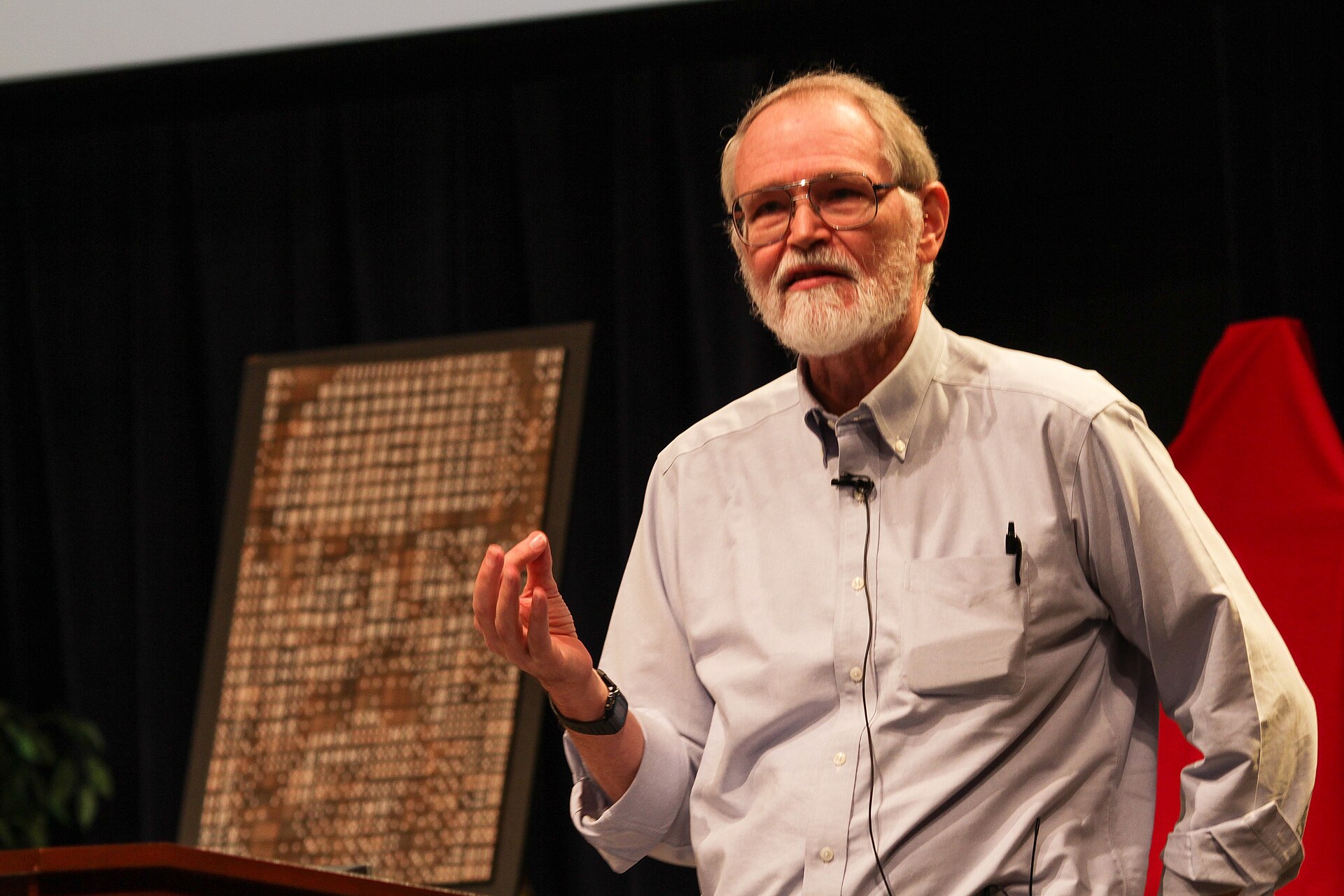
In various interviews, Brian Kernighan has stated that there was "no special intention" behind it. However, regardless of the sentence itself, the moment those words are displayed on the screen, meaning is created in two ways:
Final Verification of the Development Environment: The fact that this code works means that the compiler installation, library linking, and standard output device settings are all perfect. In other words, it is the most efficient means for the 'final check' stage of setting up a development environment.
The Beginning of Human Interaction: In the past, computers were nothing more than cold, rigid calculators. However, the moment they offer the greeting "Hello," the computer transforms into an active medium that interacts with the user. (Today, it even serves as a conversation partner for many socially isolated developers.)
Regardless of the original intent, it can be said that it helped establish the computer—which previously sought fast mathematical calculations or precise operations—as a more human and versatile tool that can be handled humanely.
'Hello World' in Modern Programming Languages
오늘날 각 프로그래밍 언어는 자신만의 문법과 철학으로 이 인사를 재해석한다.
Python (Pragmatism):
print("Hello, World!")- Pursues a conciseness that most closely resembles human language.Java (Structuralism): Permits the greeting only within the rigid framework of objects and methods. This reflects a philosophy that emphasizes the stability of large-scale system design. (Even to print one thing to the console, you must always carry around the cumbersome output library called
System.out.)Web Standard (Visual Communication): Moving away from the
printfunction, in a browser environment, it extends beyond text output to offer a first greeting as a UI component.
Closing
'Hello World' has proudly been chosen as the subject of my first post. It is the very "culprit" that ensures we keep our original intentions whenever we start or challenge something new. But is there a phrase more familiar and nostalgic to developers worldwide? I firmly believe there isn't. As it is familiar to many and hopefully somewhat helpful, I begin my blog postings to leave a record of my own.